AI-Powered BI in Practice: What These Tools Actually Do (and Where They Stop)
The three tools everyone is comparing
Power BI Copilot is the most widely deployed because it lives inside a platform most enterprises already own. You ask it things like "compare conversion rates across channels for the last six months" and it generates both the visual and a narrative explanation. Microsoft has been shipping features fast — Copilot now runs on Power BI Mobile, generates DAX measures on request, and builds entire report pages from a plain-language description. The legacy Q&A feature is being deprecated in December 2026, which tells you how seriously Microsoft is betting on this direction.
The honest limitation: Copilot doesn't reason about your data — it queries whatever is in the semantic model. If that model has three conflicting definitions of "active customer," Copilot picks one, confidently. The quality of the output is a direct function of the quality of the model underneath.
Snowflake Cortex Analyst takes a different entry point. Rather than sitting on top of a BI semantic layer, it generates SQL directly against Snowflake tables using a YAML-defined semantic model. For Snowflake-native organisations, the appeal is obvious — no extra tooling, governed access, answers grounded in the warehouse. The limitation is equally obvious: it only queries data in Snowflake, single-step answers without multi-turn reasoning, and setting up the semantic YAML upfront is its own project.
Databricks Genie is the clearest signal of where this category is heading. Genie monthly active users grew over 300% year-on-year as of early 2026, and 98% of Databricks SQL warehouse customers are now using AI/BI in some form. The most recent version has evolved beyond NL-to-SQL into what Databricks calls an "investigative agent" — capable of multi-step reasoning, decomposing why a metric moved, and generating narrative explanations rather than just returning a chart. Genie Code, its sibling product for data teams, lets engineers delegate entire pipeline and analytics tasks to an AI agent within the notebook environment.
The pattern every honest evaluation surfaces
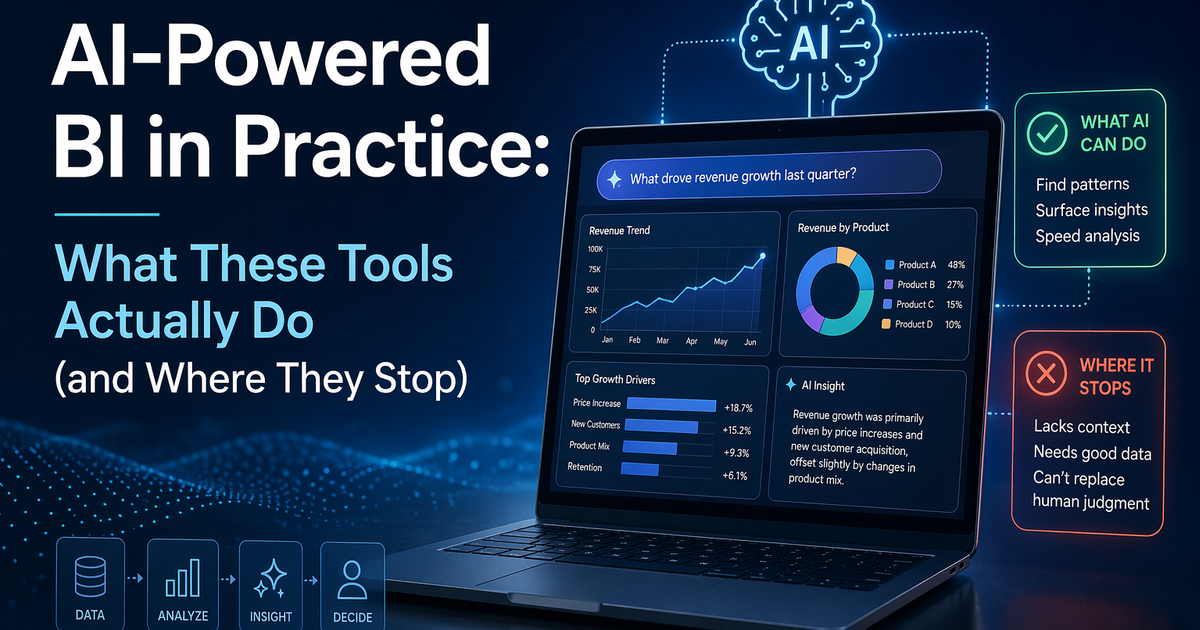
All three tools sit at what one analyst framework calls "Level 2" — NL-to-SQL agents. They translate a business question into SQL, execute it, and return the result. What they generally don't do is chain analytical steps autonomously, decompose root causes without being asked, or proactively surface anomalies before a human notices them. That investigative layer is the next frontier, and a handful of purpose-built analytics agents are starting to close that gap — but the warehouse-native tools aren't there yet for most use cases.
The other pattern: every tool in this space is only as reliable as the semantic layer it operates on. This is not a caveat — it is the central engineering decision. A well-governed semantic model with consistent metric definitions, clean naming, and documented lineage is what separates an AI analytics tool that teams trust from one that produces plausible-looking wrong answers.
The practical takeaway
If you're in a Microsoft shop and want conversational BI today, Copilot is the lowest-friction entry point — but budget time for semantic model cleanup before you roll it out widely.
If you're Snowflake-native and want governed NL-to-SQL without adding tools to your stack, Cortex Analyst is worth evaluating — with realistic expectations about answer depth.
If you're building on Databricks and need something that can handle more complex investigative questions, Genie's trajectory makes it the most interesting product to watch in this space right now.