SLM vs LLM - Not Every Task Deserves a Frontier Model. Here's How to Choose.
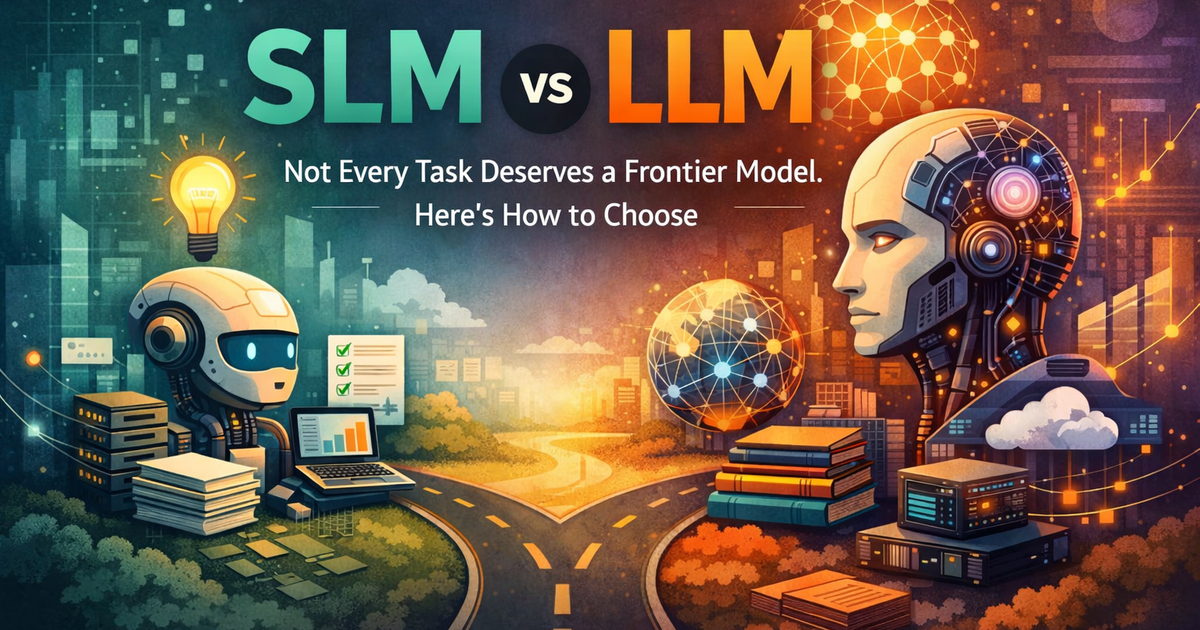
For a long time, the default answer to "which model should we use?" was the biggest one available. GPT-4 for everything. Frontier model as the baseline, then work out the cost later. It made sense when the tooling was immature and teams were still figuring out what worked — you don't optimise what you haven't validated yet.
That era is over. In 2026, defaulting to a frontier model for every task in production is roughly equivalent to hiring a senior architect to update a spreadsheet. Technically works. Wildly inefficient. And as AI usage scales across an organisation, the cost compounds fast.
What actually separates the tiers
The landscape has settled into three broadly distinct categories, each suited to a different kind of work.
Small language models — typically under 10 billion parameters — are built for speed, efficiency, and deployment flexibility. They are not inferior frontier models. They are specialists. A well-fine-tuned SLM for document classification, ticket routing, structured data extraction, or invoice parsing can match or outperform a general-purpose frontier model on that narrow task, while serving tokens in tens of milliseconds rather than hundreds, and at a cost reduction that can exceed 100x at scale. IBM's Granite models have shown up to 23 times lower cost than frontier alternatives on comparable benchmarks. The other advantage nobody mentions enough: SLMs run on-premise, which for healthcare, finance, and legal use cases isn't a preference — it's the only compliant option.
Mid-range LLMs — the 30–70 billion parameter range — cover the generalist workload well. Cross-domain reasoning, nuanced customer conversations, analysis that requires pulling together disparate context. These are the workhorses for tasks where an SLM's narrowness would break down but a frontier model's power would be overkill.
Frontier models earn their place when the task genuinely demands it: complex multi-step reasoning, autonomous agentic workflows, ambiguous open-ended problems where the inputs can't be predicted. They are expensive and slow relative to alternatives, which means every deployment decision should have a clear justification for why a smaller model isn't sufficient.
The routing pattern that's becoming standard
The most efficient production architectures in 2026 don't pick one model — they route. Simple, predictable queries go to a fast SLM. Anything requiring genuine reasoning escalates to a mid-range LLM. Complex autonomous workflows route to a frontier model. The orchestration layer handles this invisibly, and the end user never sees the switching.
This isn't hypothetical. Agentic frameworks like LangGraph make task-level model routing straightforward. The architectural decision is less about which model to choose and more about where to draw the routing boundaries.
The practical starting point
Prototype with a frontier model — it sets a performance ceiling and validates that the task is solvable at all. Once you understand what quality level is actually required, test SLMs with fine-tuning on your domain data. Define the minimum acceptable accuracy for production and measure the latency and cost you recover by going smaller. RAG and prompt tuning can close a surprising amount of the gap.
The teams getting the best ROI from AI in production aren't running the most powerful models. They're running the most appropriate ones.